
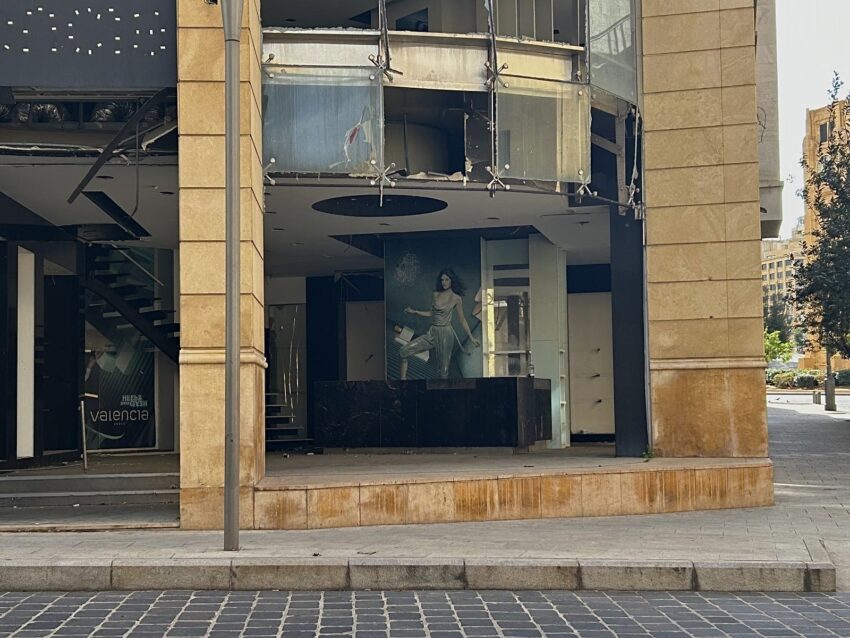
Photo by Elliot Thomas-Gregory. A blown-out window front in a shopping mall in Lebanon, Beirut.
Emily Reay
Edited by Isabelle Slentz
The city of Beirut, located at a cultural crossroads has a history dating back over five thousand years, thus the city has experienced vast change throughout its time. The marks left by the Ottoman Empire are a significant and lengthy aspect of the city’s history, as well as the colonial period under the French Mandate (1920-1943). These periods of different rule have in fact affected many aspects of life, especially within architecture and the transition into modernity, or even Westernisation. Furthermore, political and sectarian conflict throughout the Civil War (fought between many Christians and Muslims due to religious tension from 1975 to 1990) had left catastrophic damage in need of reconstruction. As the wealth gap became more prevalent, it has cemented the contrast between neighbourhoods, suburbs and the city centres, while refugee camps are also present. Therefore, this paper argues that Beirut is indeed a “city of contrasts” constructed by its deep political, societal and religious divisions within the city.
Lebanon’s cultural heritage is well-preserved throughout its capital city. Its architecture reflects French and Ottoman characteristics, often referred to as the “Paris of the East.” It is evident that the city has been influenced by former powers from the Romans until the French Mandate. Under both Ottoman and French rule, Beirut saw different modernising reforms or tactics taking place almost consecutively. In the late nineteenth century, it saw Tanzimat reforms (the reorganisation process of the social and economic aspects of the Ottoman Empire), and from the 1920s until the 1930s the duly Haussmannized, the amalgamation of modernity and cultural heritage in the city’s architecture. The end of the Civil War saw the beginning of reconstruction and restoration of Beirut through different organisations such as Solidere, founded by billionaire Rafiq Al-Hariri, who would become the Prime Minister of Lebanon. This process began with the study of the commercial city centre in 1983, and eventually the law, which was passed in 1993, to allow reconstruction. Hariri had sought to modernise the city while also preserving the cultural or colonial heritage. Within the city, the areas or squares that were the most influenced by French architecture were Achrafieh and Ras Beirut among many others. Moreover, the hybridization of architecture within the city of Beirut proves that even in its physical form it is extremely contrasting. It tells the story of the metropolitan’s people but also showcases its juxtaposition between the historical and the modern world, from the Ottomans until the aftermath of the civil war.
The city of Beirut saw division during the civil war which lasted from 1975-1990. Prior to the war, Lebanon and especially Beirut were experiencing economic prosperity—a golden age of tourism and consumerism. Beirut became a major city in the Near Eastern region, however this ended abruptly with the beginning of the civil war. The war began on April 13th, 1975, with an outbreak of violence between members from Palestinian organisations and the predominantly Maronite, Kataeb. During the war, Beirut was divided by the green line which directly cut through the city centre, including Martyr’s Square (which eventually became the most damaged area in the city by the time the war ended.) Essentially, the two halves of Beirut became classified as West Beirut and East Beirut. East Beirut had become the predominantly Christian half, and the west had become the majorly Muslim half; “The PLO/Lebanese coalition had effective control of West Beirut. The Lebanese army and traditional Christian parties were in control of East Beirut.” The city’s stark political and religious contrasts were even more prominent during this time, as it remained in the two halves, reflecting the political distinctions of the two sides. The actual fighting of the war ended in 1990, despite it being a year after the Taif Accord, an agreement which was signed in 1989. A total of around 120’000 people were killed, 300’000 injured and approximately 300’000 were displaced or homeless. The war had caused widespread destruction and tragedy throughout the city. The city which had once been thriving with modernity had now been destroyed and sectarian divide was now a prominent factor of living there. Before the war had begun, Beirut was populated by 1.5 million people, and decreased to 300,000 by 1990. Today, there is still tension between the Maronite Christians and the Sunni and Shi’a Muslims, showcasing its contrasting elements within its society which were caused as a result of the civil war.
Despite the modernised city centre of Beirut, the urban population is in direct contrast with the wealthy centre. There is a very present wealth gap in Beirut with many citizens struggling to live affordably. Since approximately 300,000 people were displaced during its civil war, Beirut has had a continuing problem with housing. The political instability in the country is a major factor for this issue, which has been a problem from the civil war until today, as a citizen’s relationship with the political party can dictate the neighbourhoods they can live, “ (one) political party opened an apartment for them to settle in, on the condition they would enroll with its militia, which they did”. As well as this, the city has a great refugee problem, while suffering through an economic crisis since 2019. In Lebanon there are twelve Palestinian refugee camps in total, three of which are located in Beirut: Shatila, Dbayeh and the Burj Barajneh camp. According to Diana Martin, the camps in Lebanon were created after 1947, “…(where) more than 750,000 Palestinians were expelled or fled from their homes and villages…”. More than 100,000 Palestinian sought refuge in Lebanon, with over 10,000 Palestinians finding refuge in just Shatila today. Moreover, the most contrasting element of Beirut is between the sleek high-rise buildings which are scattered throughout the mostly modern city centre and the many refugees and even citizens who are without homes.
Ultimately, Beirut is a “city of contrasts”, whether this is in reference to its architectural, political, or social factors. It is clear that the dynamic history of Beirut is seen in the Greco-Roman, Ottoman and French architecture while it is often the centre for political unrest between Maronite Christians and Shi’a and Sunni Muslims. In addition to this, the division of the city during the war highly represents the contrasting oppositions, as both groups each took a physical side of their city. The juxtaposition between modern wealth and poverty are stark elements seen in the city, and as discussed above the physical destruction that was left, changed its physical landscape. This city of Lebanon showcases its story on its streets, whether the history is ancient or modern, modernised or completely devastated by war; Beirut is a city of contrasts.
References
Abdelsalam, Tarek, “Reshaping the City Image: Impact of the French Colonial Architecture on the Contemporary Identity of Beirut Central District”, 2015, University of Modern Sciences & Arts (MSA), Egypt
Akar, Hiba Bou, “Displacement, Politics, and Governance: Access to Low-Income Housing in a Beirut Suburb”, Massachusetts Institute of Technology, June 2005
Harb, Mohamad Khalil, “Living and Imagining City Spaces: The Case of Beirut “, Georgetown University, Spring 2014.
Makdisi, Samir, and Richard Sadaka. “The Lebanese Civil War, 1975–90.” Edited by Paul Collier and Nicholas Sambanis. UNDERSTANDING CIVIL WAR: Evidence and Analysis. World Bank, 2005. http://www.jstor.org/stable/resrep02484.7.
Martin, Diana, ” From spaces of exception to ‘campscapes’: Palestinian refugee camps and informal settlements in Beirut”, Stellenbosch University, South Africa, October 2014
Saliba, Robert. “Historicizing Early Modernity — Decolonizing Heritage: Conservation Design Strategies in Postwar Beirut.” Traditional Dwellings and Settlements Review 25, no. 1 (2013): 7–24. http://www.jstor.org/stable/23612198.
Stewart, Dona J. “Economic Recovery and Reconstruction in Postwar Beirut.” Geographical Review 86, no. 4 (1996): 487–504. https://doi.org/10.2307/215929.