
The Fetishisation and Exoticisation of the Oriental Woman in Western Paintings
Mallak Hashem
Edited by Grace Phillips
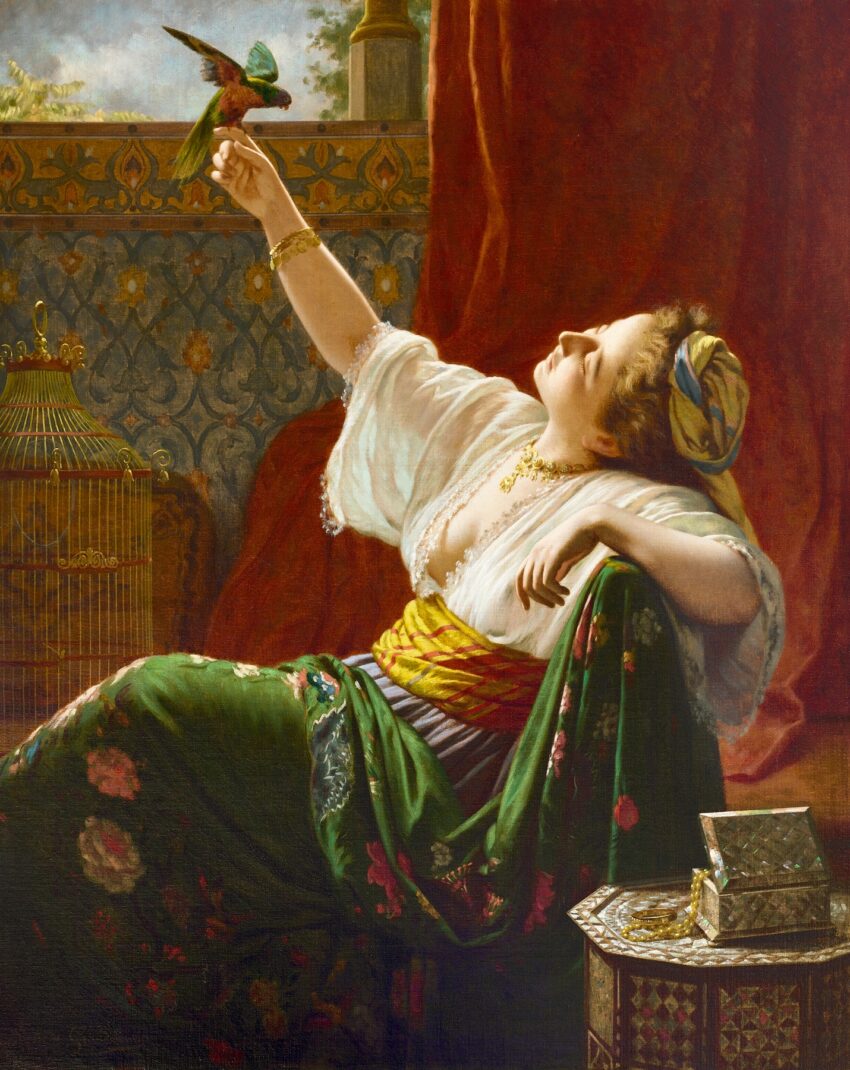
The notion that is “Orientalism” was unequivocally a transient one, given that today, the East is often perceived as barbaric, contentious and uncivilised. Yet between the seventeenth and nineteenth centuries, the “Oriental” attitude, which denoted fascination with the “exoticism” of the Orient, and promulgated the view that the East needed to be “civilised”, was the dominant one. Perhaps it was a case of “them vs. us,” as the Orient was remarkably different to Europe, and the widespread fascination with this imaginative other is evident in paintings portraying the “Oriental Woman.” In a myriad of these, the recurring themes of decadence and grandeur are consistent. While the perception of the “Oriental woman” is not entirely negative, the paintings are imbued with the attitude that the East was indolent. In almost half of the paintings, for example, the women are lounging around in their ostentatious garments. The view that the East is an indolent space is practically as old as time itself, as even Alexander the Great described the Orient as “indolent and soft”. For this reason, this study will scrutinise two paintings that this author found striking: A Beauty Holding a Bird by Louis Emile Pinel de Grandchamp (1831 – 1894), and Francesco Ballesio’s Preparing for the Dance (1860-1923).
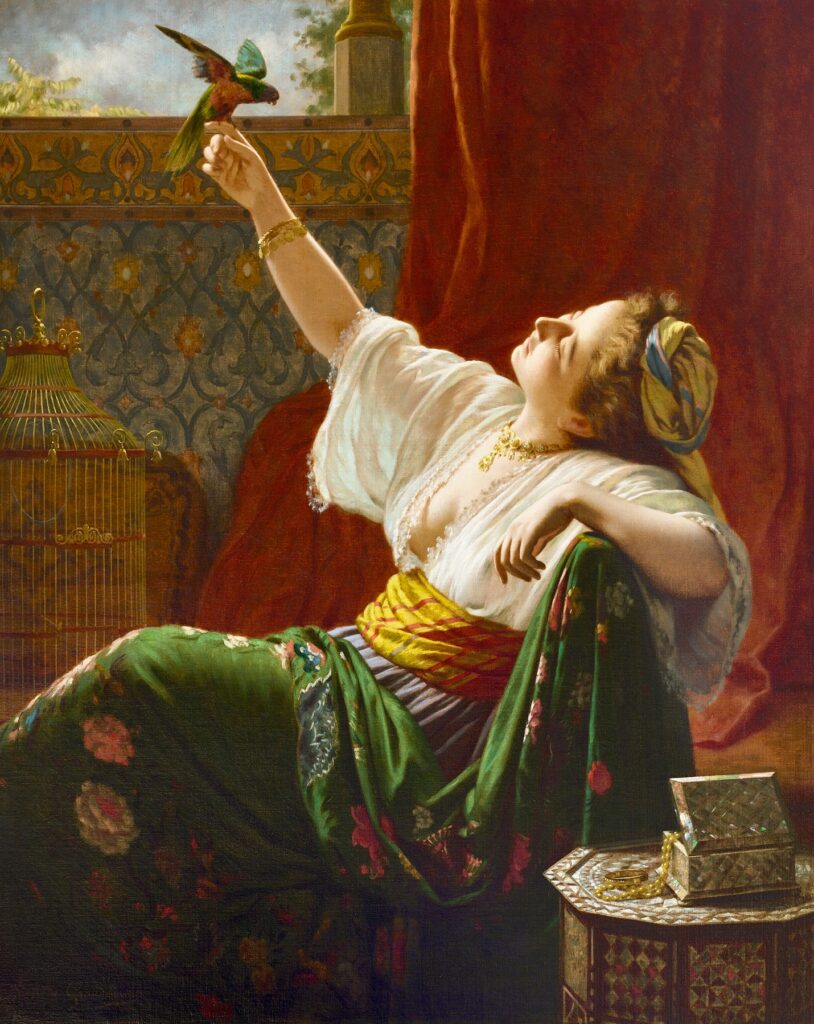
In A Beauty Holding a Bird, the woman is depicted reclining on a sofa with a bird resting on her fingers. Such a gesture perhaps encapsulates the European view towards the Orient during the nineteenth century. The woman sports a loose, silky blouse, with a vivid green skirt, which contrasts the tight-fitting corsets that European women wore. In the painting, the woman allows a bird to rest on her hand, making her seem spontaneous and exotic. The depiction of the bird is particularly striking as it allows for the interpretation that the Orient was almost tropical, or perhaps savage.
The overarching themes that make the woman in this painting Oriental are how exotic she appears, and the fact that her demeanor is very relaxed, almost Dionysian. While the concept of “Turquerie”, being the fascination with the Orient, is generally associated with the seventeenth and eighteenth centuries, it can certainly be said that it pertained to nineteenth century Western artists’ attitudes too, as Grandchamp demonstrates here. The woman in the painting seemingly harbours a seductive air. This, because the Orient was seen, during that period, “more amorous, more impulsive, and more indulgent”.
In the second painting, Preparing for the Dance, a woman is depicted admiring herself in a handheld mirror, adorned with gold and jewels. The motifs in this painting that make it “Oriental” are vanity, ostentation and indulgence. Here again, the East is portrayed as an ostentatious, yet uncivilised region which, of course, had been the Western psychogeographical stereotype since Alexander’s reign, during which period he took over Persia, and began to indulge a lavish lifestyle. In a similar manner to Grandchamp, Ballesio is fixated on the exotic fetishism of “Oriental” women, as they both portray them in a light that is as foreignised as it is striking. This sort of portrayal was nothing out of the ordinary, as during the Medieval period, “European discourse exhibits a fixation on many of the same themes… there is an emphasis on opulence, and gender and sexuality”.

The Oriental themes of opulence and indulgence prevail over any other themes, as her head and torso, which spatially dominate the painting, are covered in gold. She admires her beauty in the mirror. And a potential interpretation of the vanity is that she is indulging in one of the cardinal sins, which brings back the notion that the Orient was uncivilized and lacked morals. The Orient was seen as something to admire as well as something to belittle, since colonial myths were propagated to disparage Islam and the Orient as a whole.
In both paintings, the women are nearly portrayed as objects of desire. This plays into the European attitude that Oriental women were mere sexual objects in the Sultan’s harem, thus feeding into the historical Western view of women in Islam. In an article written by Leila Ahmed, she states that “Americans know that Arabs are backward, they know also, with the same flawless certainty that Muslim women are terribly oppressed and degraded.” She also points out that it is not only in the East that women are oppressed, but women globally. Such connotations are ubiquitous in these paintings, as the women do not seem to have their own lives but are merely there to fulfil their role that is to either satisfy the Sultan or beautify themselves for him. Along with this, they are both in “richly appointed interiors”. While European interior design was fairly ostentatious in the nineteenth century, it was certainly not as vibrant or polychromic as that of the East. This seems evident in both paintings under discussion, which once again demonstrates that the opulence of the Orient formed the imaginative counterpart to the Occident.
Grandchamp and Ballesio, both had an interest in depicting Egyptian or Ottoman women because they viewed them as beautiful and exotic. However, in the nineteenth century, the European focus shifted onto Egypt as the Ottoman Empire began to crumble and the Suez Canal had been built; this imaginative also applied to painters, thus bringing to a close the period in which depictions of “The Oriental Woman” proliferated.
Europeans often look at the East through the lens of “them vs. us” and for that reason, if they choose to praise or denigrate the East, it will always be through the othering lens. The nineteenth century was a time of colonialism, which meant that the East was viewed as a savage entity, rather than a culturally different civilisation. Through effective propagandisation, which these paintings indubitably indulge in, the European superpowers have been able to shape the views of people worldwide on how women are treated in the Arab world. Such propaganda proliferates even today. In addition to this, the normalised exoticisation of Oriental women consolidates the dehumanisation of them, stripping them of their humanity and likening them to exotic creatures, or animals. The degrading undertones presented: of the Orient as indulgent, and the women, superficial, feeds the idea that the Orient is immoral, and this seems to be the pervasive assumption of most paintings depicting Oriental women. The overarching view is that the region’s incessant indulgence of lust, vanity and decadence were symbolic of greed, and thus, it was labelled as “’uncivilised”, whereas the West — viewing itself as the paragon of human civilisation — absolved itself of those same behaviours. While paintings depicting Oriental women are generally captivating, they harbour a sense of bigotry, in the sense that they portray the Orient as exotic and uncivilised. Colonialism very evidently shaped the views of artists such as Grandchamp and Ballesio, who were both known for their affinity for Orientalism and Oriental Women. Ultimately, the depiction of these women can be characterised as a fetishisation rather than an appreciation.
References
Ahmed, Leila. “Western Ethnocentrism and Perceptions of the Harem.” Feminist Studies 8, no. 3 (1982): 521–34. https://doi.org/10.2307/3177710.
Ali, Isra. “The Harem Fantasy in Nineteenth-Century Orientalist Paintings.” Dialectical Anthropology 39, no. 1 (2015): 33–46. http://www.jstor.org/stable/43895901.
Arrian, and P. A. Brunt. Anabasis of Alexander. Harvard University Press, 1976.
Kalmar, Ivan. “The Jew and the Odalisque: Two Tropes Lost on the Way from Classic Orientalism to Islamophobia.” ReOrient 4, no. 2 (2019): 181–96. https://doi.org/10.13169/reorient.4.2.0181.
Meyer, Eve R. “Turquerie and Eighteenth-Century Music.” Eighteenth-Century Studies 7, no. 4 (1974): 474. https://doi.org/10.2307/3031600.
Said, Edward W. “Orientalism.” The Georgia Review 31, no. 1 (1977): 162–206. http://www.jstor.org/stable/41397448.